Fear of ‘Second Flood’ in Nepal and Tibet:
Glacier area shrinks by 185,000 cubic meters after accident;
bedrock supporting the glacier suspected of collapse
; “Climate change leading to massive collapses and chain disasters.”
359 dead and 910 missing in two days.
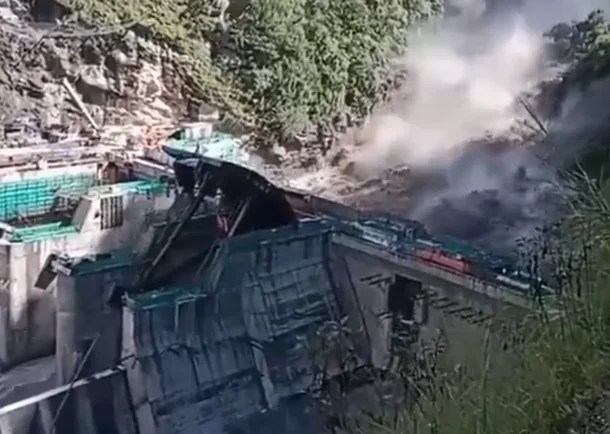
Geologists have analyzed that the massive floods in Nepal likely began with a large-scale landslide originating from a collapsed glacier. Scholars also warned that the risk of such disasters is increasing as the rate at which glaciers melt accelerates due to global warming.
Foreign media outlets, including the Washington Post (WP) and the Wall Street Journal (WSJ), reported on the 27th (local time) that geologists believe the disaster started when a portion of the glacier broke off at an elevation of approximately 10,600 feet (about 4,900 meters) in the Langtang Lirung Mountain area.
It is estimated that the glacier plunged approximately 4,000 feet (about 1,200 meters) into the valley below, and the impact caused the ice to shatter and melt, releasing a massive amount of water instantaneously that led to a large-scale flood. The mixing of rocks and sediment appears to have further amplified the destructive power of the glacial and rock avalanche.
High-resolution imagery captured by satellite monitoring firm Planet Labs shows that prior to the accident, a massive glacier stood about 4,000 feet (about 1,200 meters) above the narrow valley, with the winding Lande River flowing below. Analysis of satellite images after the accident revealed that the glacier’s surface area had shrunk by approximately 2 million square feet (about 185,000 square meters). This amounts to an area of glacier equivalent to about 25 professional soccer fields disappearing overnight.
Due to the sheer scale of the flood, scientists have raised the possibility that not only a portion of the glacier but also the bedrock supporting it collapsed along with it. Professor Umesh Haritasha, who studies earth science and sustainability at the University of Dayton in Ohio, said he is examining whether this accident is similar to the disaster that occurred in Chamoli, India, in 2021.
At that time, a massive rock and glacial avalanche also occurred as bedrock and glaciers collapsed simultaneously. Professor Haritasha said, “For floods and debris of this magnitude to be pushed downstream, a massive amount of land or ice would have to collapse all at once.”
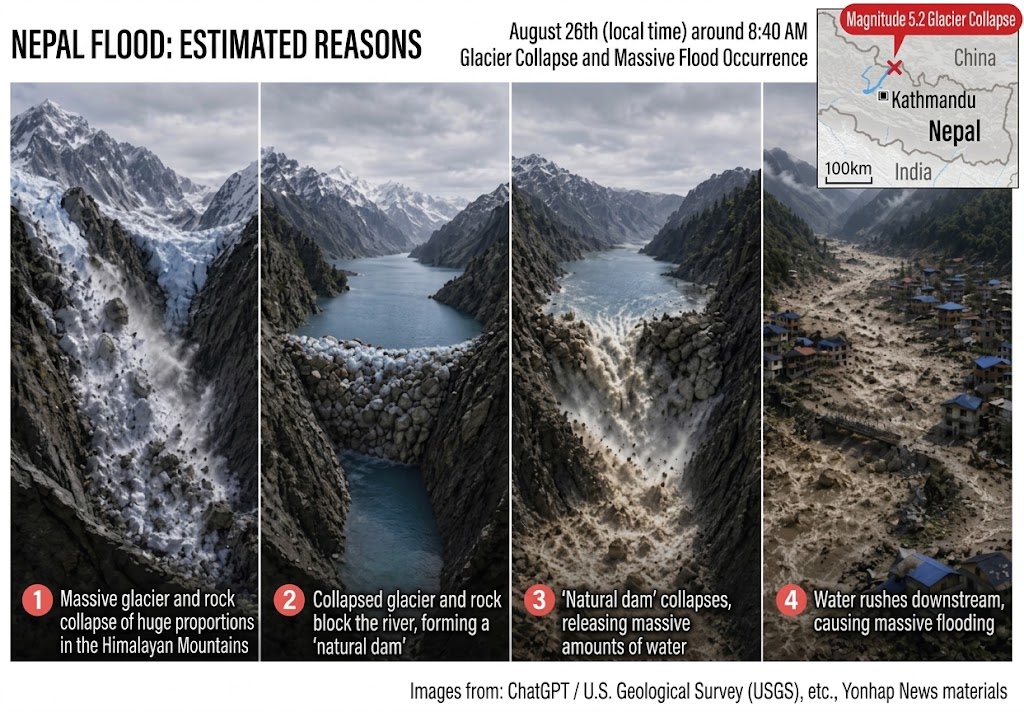
Scientists have assessed that the risk of large-scale flood disasters like this is increasing as climate change creates an environment that destabilizes bedrock and glaciers in high-altitude regions. Simon Cox, a senior scientist at the Mountains to Sea program of the New Zealand Institute of Geosciences, stated, “Climate change is creating conditions that destabilize bedrock and glaciers in high-altitude regions,” explaining that such changes could trigger large-scale collapses and chain disasters like this more frequently.
While experts caution against concluding that climate change is the sole or direct cause of this collapse, they believe it is highly likely that rising temperatures and glacial melting contributed to the disaster.
Cox explained that global warming weakens the load-bearing capacity of ice supporting steep mountain slopes while simultaneously increasing glacial melting and altering freezing, thawing, and rainfall patterns. These changes weaken mountain slopes, increasing the likelihood of large-scale collapses in certain areas.
It has also been pointed out that similar disasters have already occurred repeatedly, suggesting that nature has served as a “warning.” In recent years, this region has experienced a series of flash flood disasters of a similar type, though on a smaller scale than the recent one.
Last year, flooding occurred in the Keelung region on the border between Tibet and Nepal, and in 2024, flooding caused by the collapse of a glacial lake took place in Thame, a Sherpa village in Nepal. Prior to that, in 2023, a large-scale flood occurred in the northeastern Indian state of Sikkim following the collapse of a glacial lake.
Throughout the Hindu Kush mountain range, floods, landslides, avalanches, and droughts are becoming increasingly severe and frequent. The International Centre for Integrated Mountain Development (ICIMOD), headquartered in Nepal, pointed out that rapid changes in water, land, and the atmosphere pose a significant threat to the local population.
Farooq Azam, a senior cryosphere expert at ICIMOD, stated that as temperatures in the mountainous regions rise, the cryosphere—the region of the Earth’s surface covered in ice—is becoming much more vulnerable than in the past. He suggested that the combination of intense snowmelt and seismic activity may have triggered the initial rock and glacial avalanche, which in turn led to flash flooding downstream.
The United Nations previously stated in 2023 that due to global warming, Nepal’s snow-capped mountain regions had lost approximately one-third of their ice area in just over 30 years. At the time, the UN explained that the rate of glacial melting in Nepal had accelerated by 65% in the preceding decade compared to the decade before that. This massive flood serves as direct evidence of the devastating impact that the loss of Nepal’s glaciers can have.
Benjamin Horton, Dean of the School of Energy and Environment at the City University of Hong Kong, analyzed that this disaster could be a typical example of a “complex disaster.” A complex disaster refers to a phenomenon where natural events, such as earthquakes, combine with climate change—including glacier reduction, permafrost thawing, and mountain slope instability—to cause damage that is far more complex and severe than when each factor occurs separately.
Meanwhile, according to figures from the Nepalese police, the death toll from the floods has surged to 359 as of today. This represents more than a twofold increase from the 160 recorded the previous day. It has been reported that there are 910 missing people, of whom about 510 are foreigners. In Keelung County, Shigatse City, China’s Tibet Autonomous Region, which borders Nepal, a landslide believed to be linked to the cause of the floods occurred, resulting in 3 deaths and 558 missing people as of today. The combined number of missing people in Nepal and China’s Tibet Autonomous Region exceeds 1,400.
Please share your opinion….


Leave a Reply